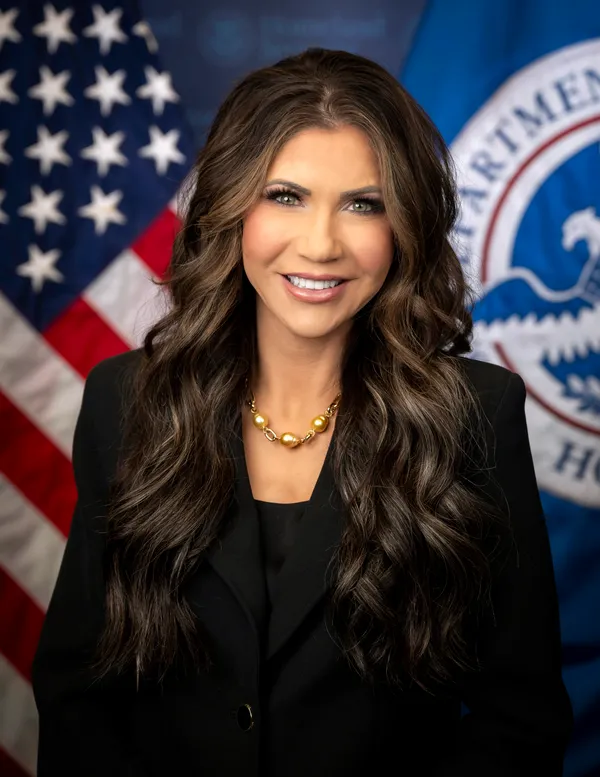
Homeland Security Secretary Kristi Noem visits Phoenix to outline federal push on election security measures
What happened in Phoenix
U.S. Department of Homeland Security Secretary Kristi Noem appeared in Phoenix on Friday, Feb. 13, to address what her office described as “election security,” using the visit to promote a pending federal proposal that would tighten voter registration requirements nationwide.
Noem’s remarks came as election policy debates intensify ahead of the 2026 cycle, with Arizona again drawing national attention because of Maricopa County’s central role in recent high-profile disputes over election administration and election outcomes.
The policy focus: proof of citizenship and voter identification
During the Phoenix stop, Noem backed the Safeguard American Voter Eligibility (SAVE) Act, a measure advanced in Congress that would amend the National Voter Registration Act to require documentary proof of U.S. citizenship for registration in federal elections. The bill also lays out acceptable forms of proof and includes provisions that would increase coordination between federal agencies and state election officials on citizenship and registration issues.
The House of Representatives approved the bill this week by a narrow margin, placing the proposal at the center of an evolving Senate debate over whether federal standards should be expanded in areas traditionally managed by states.
- The bill’s core requirement is documentary proof of citizenship for voter registration in federal elections.
- It specifies categories of documents that may qualify as proof and outlines steps for election officials to verify eligibility.
- The legislation includes duties for the Department of Homeland Security related to notifying election officials when individuals become naturalized citizens.
Who joined Noem and why Maricopa County matters
Noem was joined by Maricopa County Recorder Justin Heap, whose office is responsible for voter registration and other election-related administrative functions in Arizona’s most populous county.
Maricopa County remains a focal point of national political attention after the 2020 presidential election, when the county’s vote totals closely tracked Arizona’s statewide margin. The episode triggered sustained legal and political conflict, including repeated public scrutiny of the county’s election processes.
DHS and elections: a defined but limited role
The Department of Homeland Security does not administer elections. However, DHS has had an established role in supporting election security through cybersecurity assistance and coordination since election infrastructure was designated a critical infrastructure subsector in January 2017. In practice, that federal role has focused on technical support, threat information sharing, and resilience planning, rather than directing how states run elections.
The Phoenix appearance highlighted a shift in emphasis from technical election security support toward advocacy on election administration policy now under congressional consideration.
What to watch next
The SAVE Act now moves to the Senate, where its prospects will depend on procedural hurdles and intraparty negotiations. In Arizona, state and county election officials will be watching for details on how any federal changes could affect registration processes, document verification workloads, and election timelines heading into 2026.
For voters, the immediate practical impact hinges on whether the proposal becomes law and, if so, how implementation standards are defined and phased in across states.